
Author
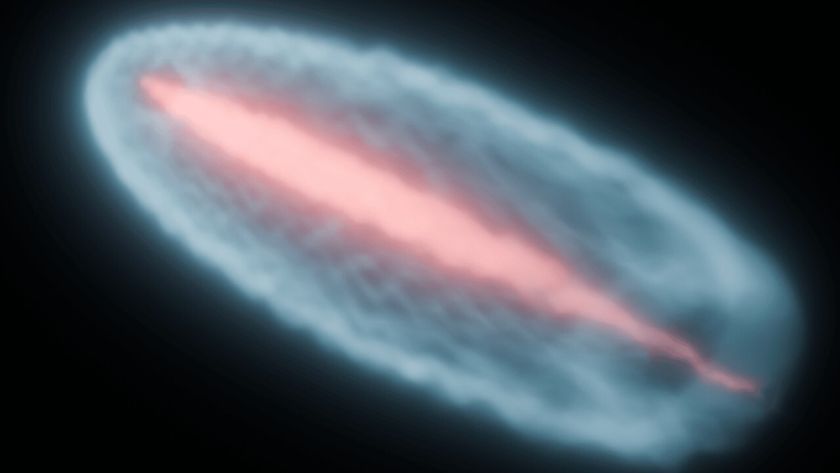
It was reported that High-energy ‘sun goddess’ particle ‘from nowhere’ collides into Earth. The news astonishingly shaken the scientific world and researchers were panic to know the fact behind the surprises.
Researchers have finally discovered an extremely high-energy particle that seemingly came from a part of the universe where there is nothing. It was named “Amaterasu” after a Japanese Sun goddess. Scientists have detected one of the most powerful cosmic rays ever slamming into Earth but they have no idea what caused it or where it came from. The extremely high-energy particle is seemingly arrived from a void in space where nothing is known to exist.
According to the news agency “The Guardian” The said particle has an energy exceeding 240 exa-electron volts (EeV), which is millions of times more powerful than the particles produced by the Large Hadron Collider,is the most powerful accelerator ever built. It is second only to the “Oh-My-God” particle, another high-energy cosmic ray detected in 1991. That came in at 320 EeV.Toshihiro Fujii, who is an astronomer at the Osaka Metropolitan University in Japan, observed some peculiar signals while he was doing a routine data check at the Telescope Array Project in Utah. The signals that came on May 27, 2021, suggested that something super-energetic had smashed into the facilities’ detectors, but he was skeptical about it. The measurements pointed towards ultra-cosmic rays whereas when the researchers tried to find the source of the energy spike, they found nothing, according to Nature.
Ultra-high energy particles like Amaterasu usually travel through space quite smoothly since they don’t bounce off magnetic fields, like low-energy cosmic rays. Technically, this should make it easier to pinpoint the location where it came from, but that was not the case.Based on the researchers’ calculation, the ray seems to have come from a void-like region where few galaxies exist. The scientists were double-checked their calculations and even tried matching the cosmic ray to possible source galaxies and other objects just outside their arrival direction. Even that did not work — nothing fit.
The scientists propose three explanations for the enigmatic origin of the particle
1) it could be from a source that we have not yet identified.
2) It might have been magnetically deflected much higher than current models predict.
3), scientists might need to rewrite their incomplete understanding of high-energy particle physics.
“If you take the two highest-energy events — the one that we just found, the ‘Oh-My-God’ particle — those don’t even seem to point to anything. It should be something relatively close. Astronomers with visible telescopes can’t see anything really big and really violent, said John Matthews, co-author of a paper on the particle published in the journal Science to CNN.The Telescope Array started operations in 2008 and consists of 507 large table-sized surface detectors that cover a combined 700 square kilometres. The Array has observed more than 30 ultra-high-energy cosmic rays but none were bigger than the Amaterasu particle.