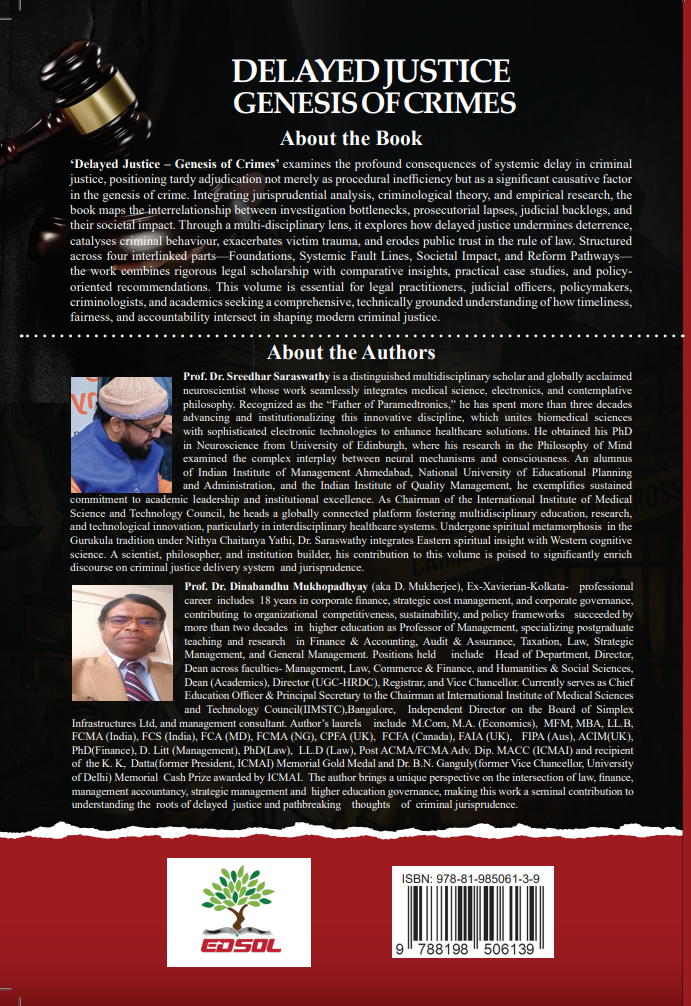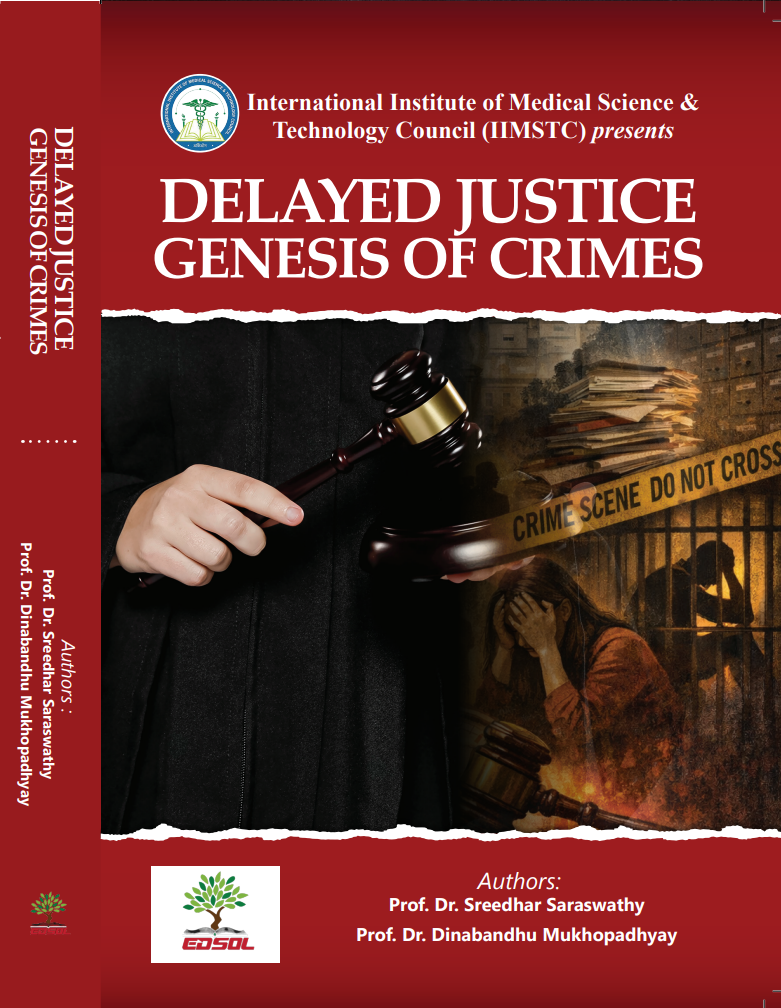

Author
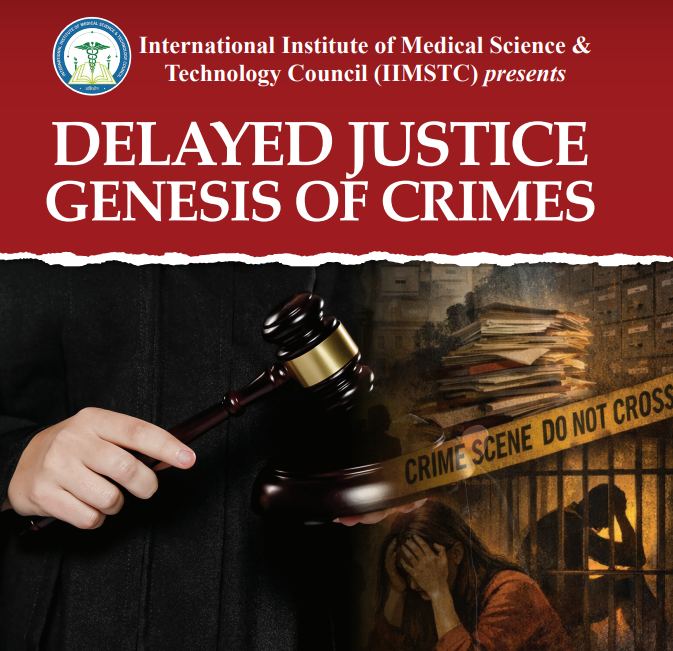
Book overview
Criminal justice systems across jurisdictions are confronting a paradox of the modern age. While legal frameworks have expanded, rights discourse has matured, and procedural safeguards have multiplied, crime continues to evolve in scale, sophistication, and audacity. Organized crime, cyber-enabled offences, economic frauds, violent recidivism, and street-level vigilantism coexist with unprecedented delays in investigation, prosecution, and adjudication. This book proceeds from the central premise that delay in criminal justice is not merely an administrative deficiency but a generative force in the production and perpetuation of crime itself.
Contemporary crime trends reveal a disturbing pattern: offenders increasingly calculate risk not against punishment prescribed by law, but against the probability and timing of its enforcement. Where certainty and swiftness of justice erode, deterrence weakens. Prolonged investigations, endless adjournments, mounting case backlogs, and years—sometimes decades—of unresolved trials create a justice vacuum. Into this vacuum enter cynicism, impunity, retaliation, and alternative— often violent—modes of dispute resolution. Delay thus becomes criminogenic: it shapes behaviour, incentivizes law-breaking, and normalizes illegality.
At the same time, victims of crime experience justice not as a corrective process but as a prolonged ordeal. Contemporary victimology records rising levels of secondary victimization caused by repeated court appearances, procedural uncertainty, and social stigma during long-pending cases. In many societies, this has contributed to declining reporting rates for certain offences and an increasing reliance on informal settlements, coercive compromises, or vigilantism. These responses, while understandable, further weaken the rule of law and contribute to cycles of violence.
Equally significant is the impact of delayed justice on the accused. The growth of undertrial populations, prolonged pre-trial incarceration, and unresolved criminal charges hanging indefinitely over individuals have emerged as defining features of modern criminal justice. Contemporary crime data shows how prolonged exposure to carceral environments and social exclusion hardens identities, increases recidivism, and converts marginal offenders into habitual criminals. Delay thus blurs the line between adjudication and punishment, often before guilt is determined.
Technological advancement and globalization have accelerated crime, but criminal justice institutions have not adapted at a commensurate pace. Cybercrime is transnational and instantaneous; financial crimes are complex and document-heavy; organized criminal networks are agile and adaptive. Yet procedural systems remain burdened by legacy processes, rigid formalism, and fragmented accountability. The resulting mismatch between the speed of crime and the slowness of justice lies at the heart of contemporary criminal justice failure.
This book situates delayed criminal justice within this broader socio-legal context. It argues that delay is not an incidental by-product of complexity but a structural condition that reshapes criminal behaviour, institutional credibility, and social norms. By tracing the genesis of crimes through systemic delay, the work moves beyond conventional analyses that focus solely on poverty, morality, or enforcement gaps. Instead, it interrogates how the temporal dimension of justice— how long the law takes to respond—directly influences crime creation, escalation, and normalization.
The structure of the book reflects this analytical progression. The opening part lays the conceptual and jurisprudential foundation, examining delay as a legal, psychological, and constitutional phenomenon. The second part dissects institutional fault lines within investigation, prosecution, and adjudication that convert delay from exception to routine. The third part connects these systemic failures to contemporary crime trends, demonstrating how delayed justice reshapes victim behaviour, accused identities, and societal tolerance for crime. The final part turns toward reform, emphasizing that timely justice is not merely an efficiency goal but a core requirement of legitimacy, deterrence, and social trust.
In an era where public confidence in legal institutions is increasingly fragile, this book contends that speed, fairness, and certainty must be restored as central pillars of criminal justice. Without addressing delay as a root cause, reforms aimed solely at harsher punishments or expanded policing risk aggravating the very conditions that generate crime. Delayed Criminal Justice – Genesis of Crimes is thus offered as both a diagnostic and a call for re-imagining criminal justice in alignment with contemporary realities.
Prof. Dr. Sreedhar Saraswathy
Prof. Dr. Dinabandhu Mukhopadhyay