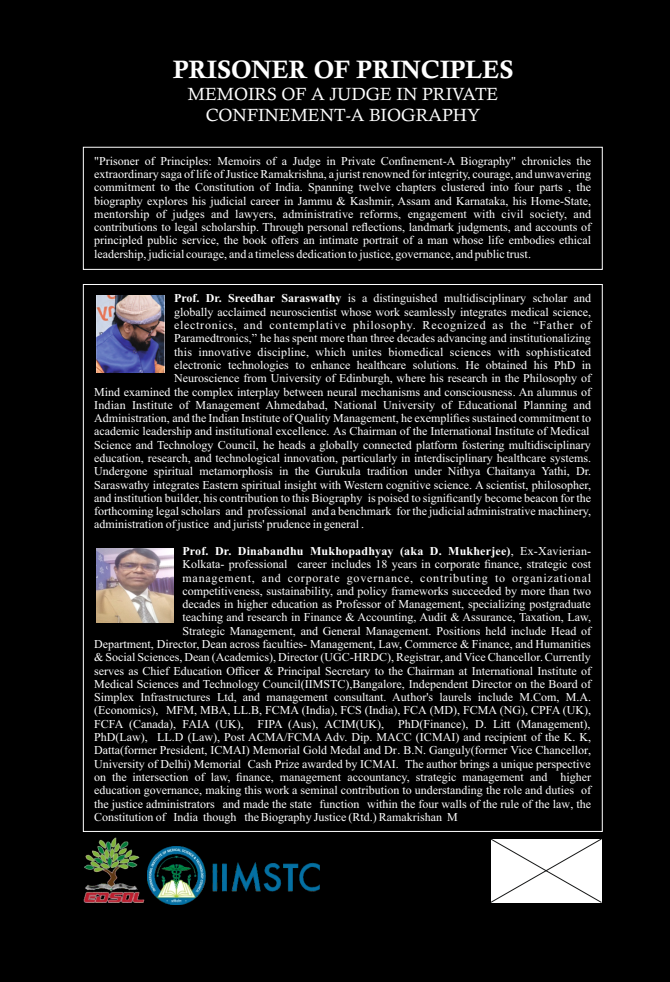

Author
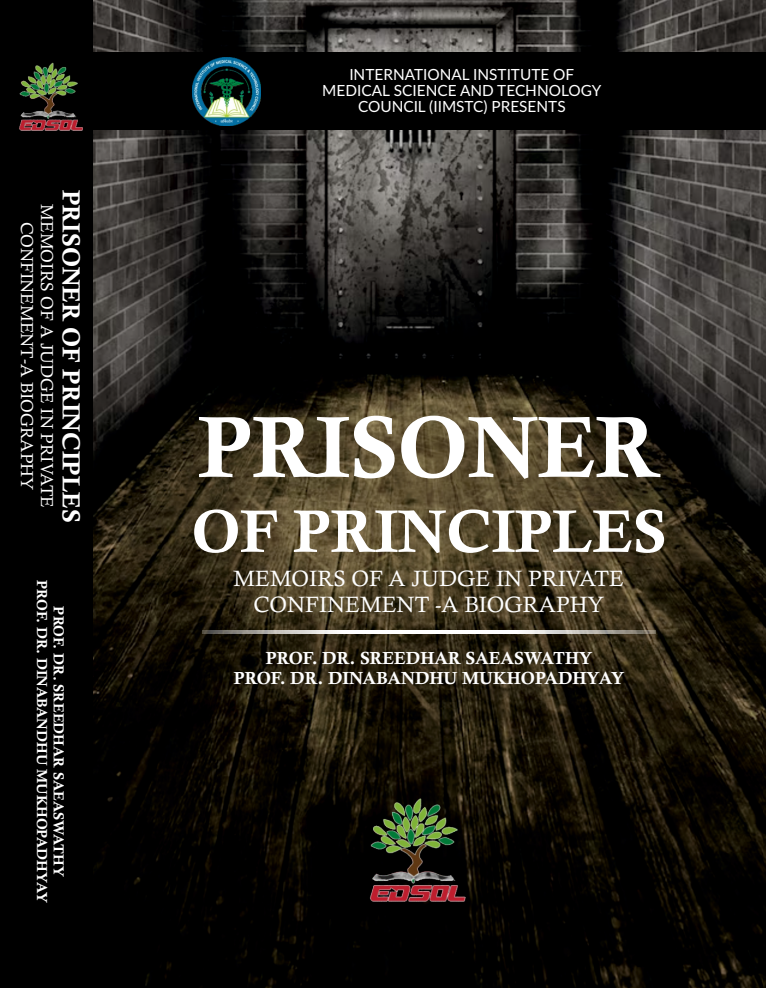
Book overview
The life of a judge is often imagined as one of measured deliberation, quiet reflection, and public authority. Yet for Justice Ramakrishna, this image was only a part of the story. His career, spanning decades across some of India’s most challenging legal and political landscapes, reveals a journey defined as much by personal courage and ethical rigor as by judicial acumen. Prisoner of Principles is not merely the story of a man who presided over cases or guided courts; it is the chronicle of a jurist whose conscience never wavered, even when confronted with circumstances that tested the very foundations of law, morality, and governance.
From his early days on the bench in Jammu and Kashmir, through a transformative tenure as Chief Justice in Assam, to his post-retirement engagements shaping legal thought and civic trust, Justice Ramakrishna’s journey illustrates the tension between principle and expedience. It is a journey marked by landmark judgments and procedural reforms, but also by private reflection, mentorship, and the silent cultivation of integrity that often went unnoticed beyond the walls of courtrooms.
The title of this biography, Prisoner of Principles, captures the paradox of his career. While his position afforded immense authority, it was bound by the ethical, moral, and constitutional obligations he refused to compromise. Circumstances— political pressures, regional instability, and the challenges of enforcing justice in contested territories—often created constraints, making the pursuit of principle a lonely and demanding endeavour. Yet it is precisely this adherence to conscience over convenience that defines the extraordinary quality of his legacy.
Throughout this work, readers will encounter Justice Ramakrishna not only as a judge but as a mentor, administrator, scholar, and citizen. His life beyond the bench reflects the human side of jurisprudence: a man who engaged deeply with colleagues and students, who valued dialogue over dogma, and who believed that the judiciary’s moral authority depends as much on integrity and transparency as on legal reasoning. His mentorship shaped the careers of judges and lawyers across generations, reinforcing the idea that the influence of a jurist extends far beyond individual rulings.
The biography also traces the broader societal and civic impact of his work. From advocating for judicial reforms in the North-East, to protecting constitutional rights in regions affected by unrest, to engaging with civil society for legal literacy, Justice Ramakrishna consistently demonstrated that law must serve people, not power. In these pages, his reflections on democracy, governance, and ethical leadership are woven with narratives of procedural reforms, landmark judgments, and the challenges of maintaining public trust under extraordinary conditions.
PRISONER OF PRINCIPLES.indd 5 01-04-2026 22:38:27 Prologue vi Prisoner of Principles is structured into twelve chapters, each exploring a distinct phase of his life and career. Early chapters examine his formative years and judicial practice in Jammu and Kashmir, highlighting the delicate interplay of law, politics, and civil society. Middle chapters illuminate his administrative and mentorship roles in Assam and the North-East, revealing how ethical leadership and personal courage shape institutions. The concluding chapters provide a reflective panorama of his jurisprudential legacy, societal contributions, and enduring principles, offering lessons for judges, lawyers, policymakers, and citizens alike.
This biography is also a meditation on the nature of justice itself. Justice Ramakrishna’s career illustrates that the law is not merely a mechanism of adjudication, but a living instrument of moral and social responsibility. His example demonstrates that judicial courage is measured not by popularity or acclaim but by steadfast commitment to truth, fairness, and the protection of rights, even in adversity. His life is a reminder that the legitimacy of legal institutions rests upon the ethical, intellectual, and moral conduct of those who serve within them.
As readers turn these pages, they will witness the journey of a jurist who refused to compromise with expedience, whose guidance nurtured the next generation of legal minds, and whose reflections continue to illuminate the path of principled public service. Prisoner of Principles is both a record and a tribute—a chronicle of extraordinary professional courage, and a testament to the enduring power of conscience in the pursuit of justice.
Justice Ramakrishna’s story is not only that of a judge bound by the Constitution; it is the story of a life committed to principles that transcend tenure, geography, or circumstance. It is the story of law exercised with wisdom, integrity, and courage—a story that continues to inspire, instruct, and resonate with all who seek justice in both letter and spirit.
Prof. Dr. Sreedhar Saraswathy
Prof. Dr. Dinabandhu Mukhopadhyay